A journey into a 1960s obsession—and the discovery that sometimes the best purchase is the one you don’t make.
August 2026
I’ve been looking forward to retirement in a few years, and one of my goals is to have a small RV—maybe a Sprinter or something similar—that I can drive easily and use for comfortable trips and overnight stays.
So I’ve started looking.
I’m trying not to get too serious about it because retirement is still a few years away. But then, on a Monday, a Facebook Marketplace listing appeared that completely derailed that plan.
It was a 1966 Corvair Ultra Van.
It was the perfect size. It was incredibly funky-looking. It looked like a whale.
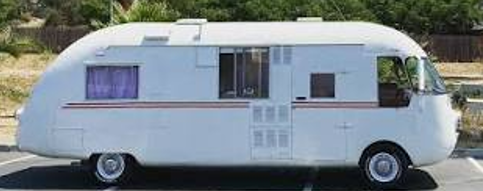
I was immediately intrigued.
I started Googling it and discovered that Ultra Vans weren’t built like conventional RVs. They were aircraft-inspired vehicles, with an aluminum monocoque structure and an unusual Corvair drivetrain mounted in the rear.
The more I learned, the more interesting it became.
Then I came across a Facebook video featuring a woman I recognized from social media. She does beauty, fashion, and home-goods content, and although I don’t follow her, I recognized her immediately. She was standing next to her newly acquired 1960s Ultra Van, dressed as though she’d just stepped out of a Trina Turk catalog.
Then she gave a tour of the inside.
It was pure 1960s retro.
“Oh, my God. I have to have this thing.”
At this point, anyone who knows me would probably say, “Greg, you’re crazy.”
They wouldn’t be wrong.
It was listed for $25,000.
I tried to get it out of my head.
That didn’t work.
Enter Al
Two days later, after my continued obsession and research into Ultra Vans, I was going to see my friend Al in San Clemente.
Al is a lifelong classic-car collector who appreciates older vehicles and their history. I thought he might get a kick out of hearing about my recent obsession. With his experience, I figured he might also be a good person to help me walk through my thoughts.
I told him about the Ultra Van.
He was slightly intrigued but mostly cautious.
I continued researching.
I found estimates that fewer than 400 Ultra Vans had been built and fewer than 70 remained on the road. There was even a Corvair Ultra Van Club, whose members had been documenting these unusual vehicles for decades.
Then I discovered something even more interesting.
Ultra Vans were serialized. Using this particular one’s serial number, I found its purchase history and other details online.
I learned about its early owners. In old club records and discussions, I found accounts of a previous owner who had apparently kept it in very good condition and rarely used it.
Then I found someone on a Corvair forum who had been discussing this particular coach for years.
I started piecing together his username, his posts, and his connection to the Corvair community. Eventually, I realized he was a longtime owner and Corvair parts specialist.
So I found his email address and wrote to him.
An email from the former owner
He responded almost immediately.
He told me he had owned the Ultra Van for more than 20 years. He had bought it from the second owner, a man already in his 80s who had owned it since the early 1970s. According to his account, that owner had stored it carefully and rarely used it.
The former owner also described several changes he had made during his time with the coach: replacing the engine, swapping the automatic transmission for a four-speed manual, replacing the wheels and hubcaps, and restoring the unusual flip-up “coffee bar” inside.
Reading about its history and that little coffee bar made it even harder to stop thinking about it.
“Oh, crap. I really might have to buy this thing.”
I shared all of this with Al.
Al thinks I’m crazy
His reaction was basically:
“Greg, you’re crazy.”
He pointed out that this was a 1966 vehicle and asked whether I had any idea how much money I might have to put into it.
I told him that if the engine and mechanical systems were in good shape, and the interior was reasonably intact, I could restore the interior over time and bring it back toward its original 1960s appearance.
He wasn’t convinced.
But something interesting happened.
Al started researching it himself.
He found two other Ultra Vans for sale—one in Albuquerque and another in Oregon. One was about $20,000, and the other was $17,500.
Suddenly we had three Ultra Vans to compare.
And because we had their serial numbers, we could use AI to help us search for more of their history.
Al was getting completely sucked into the research.
He still thought I was crazy.
But now he was curious, too.
A second opinion
Al suggested that I talk to a longtime friend of his who also collects and restores older cars. Al thought he had some experience with vintage RVs.
So Al forwarded him some of the information we’d found, and his friend agreed to talk with us.
At the beginning of the conversation, he said he had a question for me.
“If I told you to take $25,000 out of your savings today, go to the casino, bet it all on black, and lose—would that negatively impact you financially?”
I thought about it.
“Yeah,” I said. “It would hurt. But it wouldn’t ruin me.”
“Okay,” he said. “Then I think you should do it.”
He wasn’t telling me to gamble. I took it to mean I could afford to take a chance on something I really wanted.
He also pointed out that I rarely do anything just for myself. He thought I’d done enough research to justify seeing the Ultra Van.
His advice was essentially: Go look at it. If you love it, don’t necessarily buy it on the spot. Hire someone who knows Corvairs to inspect it. And become best friends with the former owner—the Corvair parts specialist I’d been emailing.
Meanwhile, Al was sitting there with his hands on his face. I could practically hear him thinking, “You are giving Greg exactly the wrong advice.”
We all laughed about it.
But I decided I had to see the Ultra Van.
The road trip
The seller and his wife had recently moved to Colorado, so the Ultra Van was being stored with the seller’s father in a mobile-home community near Valley Center, California.
I arranged to see it on Sunday.
I had originally planned to go home that day, but I asked the friend we were staying with in San Clemente if I could stay another night.
Then I asked Al if he wanted to come with me.
He immediately said, “Oh my gosh. I would love it.”
So Sunday morning, Al and I set off.
The drive from San Clemente took about an hour and a half. We decided to stop for lunch along the way, and I asked Al whether he liked Arby’s.
I always have a hard time passing an Arby’s. I loved their sandwiches growing up in Utah. When I moved to California to start my career and was making very little money, I’d take advantage of the five-for-$5 roast beef specials. I’d buy $20 or $30 worth of sandwiches, freeze them, and add them to my work lunches.
Al told me he hadn’t had Arby’s in about 20 years.
I told him there was one in Escondido on the way to see the coach.
When we got there, he discovered they had a French dip sandwich. Then he asked the woman at the counter, “Do you have horseradish?”
She pointed him toward the dispenser.
“You have a dispenser of it? Love it!”
We sat there eating our Arby’s and having a wonderful time.
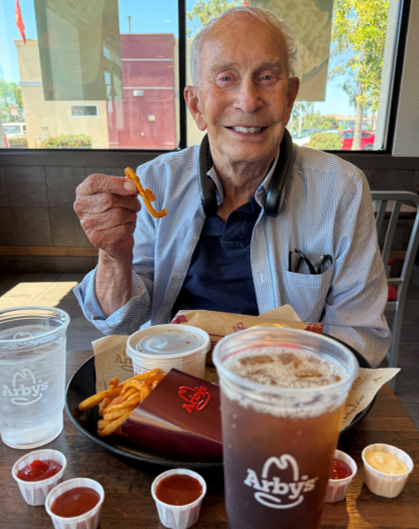
The whole trip was turning into an adventure before we’d even seen the Ultra Van.
Meeting the seller’s father
After lunch, we continued east of Escondido, into the hills.
The drive became beautiful—winding roads, big rocks, a lake, and increasingly impressive scenery.
Eventually we reached the mobile-home community. It was surprisingly beautiful. The entrance looked more like a country club than a mobile-home park, with homes on large lots surrounded by winding roads and hills.
We found the property where we’d arranged to meet. Several covered vehicles and multiple golf carts sat around the house.
I knocked on the door. The doorbell didn’t work.
Eventually a dog started barking, and the seller’s father came to the door. He seemed a little confused about why I was there.
I introduced myself and told him I was there to see the 1966 Corvair Ultra Van.
“Oh, oh,” he said.
He told me he needed to put on some socks and shoes. Eventually he came out, uncovered a golf cart, and we followed him to the RV parking area.
And there it was
The Ultra Van was completely covered with a fitted RV cover.
Al and I looked at each other.
“Wow.”
The first thing we both noticed was how small it was. It was much more compact than we’d expected.
That was actually a good thing.
We pulled up next to it, and the seller’s father started removing the cover.
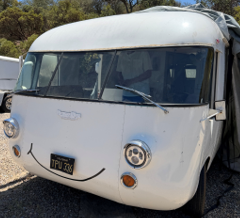
I was trying to figure out how to get Al inside. He had brought his walker and scooter, and we’d already discussed which would be easier on the gravel.
But when we got to the door, we realized the step was simply too high for him.
He could probably have managed it, but it was hot, we were standing in full sun, and Al was already beginning to experience one of his hot flashes.
So I decided to get him back into the air-conditioned car.
That was when things became interesting.
The gasoline fumes
The seller’s father kept talking to us; he had removed the cover from the front of the coach and just far enough back to access the door; the rest of the coach remained covered.
He told us his son had purchased it in British Columbia and had it transported to California on a flatbed because it didn’t have brakes. He said his son later redid the brakes, upgraded the suspension, and worked on the engine.
Those were the details he gave me; they contradicted the vehicle history I found online and the details the previous owner provided via email.
Then he went inside and tried to start the engine. I heard him explain that he’d recently had trouble starting it and that his son had given him instructions on how to get it going.
He kept turning the engine over.
Then I smelled gasoline.
A lot of gasoline. And two-thirds of the coach was still under the cover!
I got Al back to the car and made sure he was comfortable. Meanwhile, the seller’s father was on the phone with his son, trying to figure out why the engine wouldn’t start.
I went back over. Inside the Ultra Van, the gasoline smell was strong.
“Aren’t you going to remove the rest of the cover?” I asked. “The engine is in the back.”
He said the exhaust was below the cover, so it was okay.
“No,” I told him. “You don’t need to start it. Please stop trying to start it.”
His son was still on the phone, and we were introduced. I said hello and explained that we were simply there to look at the coach. If we decided we were interested, we’d have a mechanic inspect it.
I didn’t want to spend another minute with an engine cranking inside a partially covered, 60-year-old RV while I could smell gasoline in the cabin.
Then I looked inside
While all of that was happening, I’d already gotten enough of a glimpse inside to know something.
I went back to the car and looked at Al. Apparently I had a huge smile on my face. He later told me I looked like the Cheshire Cat.
I leaned into the car and whispered, “Al, don’t worry. I had enough time to look inside. The answer is no.”
Relief washed over his face.
“Oh my gosh. Thank goodness, Greg.”
I went back inside and took a quick look around.
The interior didn’t match the impression I’d gotten from the listing photographs. I wondered how recently those photographs had been taken.
The stovetop was askew, and I could see rust coming through the chrome trim.
The flip-up bar the former owner had described was still there, but its laminate appeared to have shrunk around the edges and was peeling away.
The built-in cabinet doors looked warped. Some of the cabinets had exposed insulation. Above the bed, I could see water stains running down both sides of the interior wall below the rear window.
I couldn’t tell when those problems had developed or what work had been done in the meantime. But what I could see was enough: this was a much bigger project than the one I’d imagined.
I didn’t even bother checking the instrument panel or looking for the mileage.
I didn’t need to.
I’d seen enough.
The answer was no
I walked back outside and thanked the seller’s father.
“I’m not going to waste your time,” I told him. “I really appreciate you showing this to me, but this is a much bigger project than I’m willing to take on. My answer is no.”
He was perfectly gracious.
He told me he’d taken a road trip with his son in the Ultra Van to Palm Springs and attended one of the Ultra Van club gatherings. He described the people in the Ultra Van community as extreme enthusiasts.
After all my research, I could understand the enthusiasm.
But I realized something on that trip:
I wasn’t that kind of enthusiast.
I shook his hand, thanked him again, and got back in the car.
The best part
Al and I drove home.
And we laughed.
We laughed about the whole thing. We laughed about how much research we’d done, about Al’s friend encouraging me to buy it, and about Al trying to talk me out of it.
We laughed about the Arby’s French dip.
Once we were safely on our way, even the gasoline-fume scene became part of the story we were retelling.
And most of all, we laughed about the fact that after all that research, all that history, all the emails, the comparisons, the AI research, and the road trip…
I knew within about ten minutes that I absolutely did not want the Ultra Van.
And honestly, that was okay.
I didn’t come home with a 1966 Corvair Ultra Van.
But I did come home having spent a wonderful day with Al, who had become just as fascinated by these strange little vehicles as I had.
And perhaps that’s the better story.
I started out looking for an RV for my future retirement. Instead, I found an obscure piece of 1960s automotive history, went down an incredible research rabbit hole, turned it into an adventure with a dear friend, and discovered that sometimes the best purchase you can make…
is the one you decide not to make.
Enjoyed the story? Join LittleDevlin for free to read without ads and add your thoughts to the conversation. Have you ever gone to look at something you were convinced you wanted—and come home glad you didn’t buy it?
Leave a Reply
You must be logged in to post a comment.